Communal Water, Invisible Labor: Modeling the Social Impact of Pompeii's Street Fountains
Lecture by Matthew Notarian, Associate Professor of Classics, Hiram College
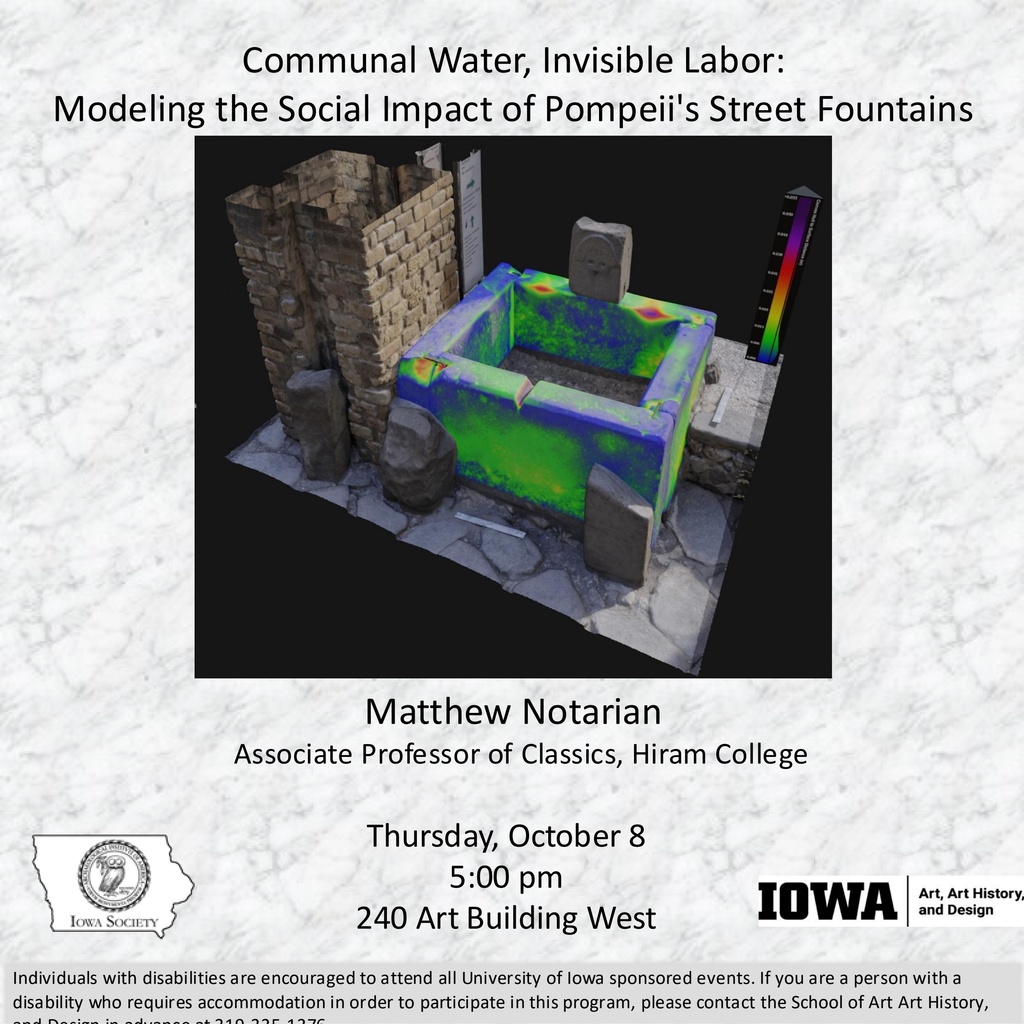
The remarkable preservation of the Roman city of Pompeii provides unprecedented insight into an aqueduct-fed urban water system. Visitors often marvel at the city’s network of public street fountains, but few consider the practical consequences of the tedious but essential labor required to transport water into living spaces. Fountains served as neighborhood hubs, channeling movement through streets and facilitating social interactions. Their distribution also influenced water accessibility, with severe implications for public health and socioeconomic status. The burden of water collection fell heaviest on those at the margins of Roman society – subelite women, children, and, especially, the enslaved – classes which are virtually invisible in the textual and visual record. This talk will present the results of a complex digital spatial model that sheds light on these issues at a household-level scale, as well as an ongoing project of 3D analysis that aims to quantify use-wear on public fountain basins. Together, they represent a significant first step toward repopulating Pompeii’s streets with indispensable but often forgotten laborers.